
Among the most recurring and, paradoxically, most confusing words in software engineering, domain holds a central place. It is one of those words that feel safe, technical, almost self-explanatory, until someone asks what it actually means. In an architecture meeting, when a developer mentions "domain layer," what does that really mean? For a team that adopts hexagonal architecture, the expression might refer to the business core isolated from ports and adapters.
For those who practice DDD (Domain-Driven Design), it could refer to the set of entities, aggregates, value objects, and domain services that express the Ubiquitous Language. For those who follow Clean Architecture, it could mean both entities and use cases. And for a DBA working with PostgreSQL, "domain" might simply designate a custom data type with validation constraints.
This polysemy, when left unacknowledged, generates semantic noise that manifests as technical noise: misguided architecture decisions, misallocated responsibilities, blurred boundaries, and conversations that seem to agree but describe completely different things. The problem is not merely terminological. It is structural. When two architects discuss "where domain logic should live," they may be talking about fundamentally different concepts without realizing it. One believes use cases belong to the domain; the other insists that domain means only pure business rules, without orchestration. Both use the same word, but they do not share the same concept.
The philosopher Ludwig Wittgenstein wrote, in Philosophical Investigations, that "the meaning of a word is its use in the language." Software engineering is, above all, a technical and social language, and the term domain shifts meaning depending on the language game in which it is employed. Failing to understand this game is the starting point of many conflicts between architecture, design, and implementation teams. It is also the origin of poorly structured systems, where the original architectural intent is lost in successive and poorly understood translations.
There is something ironic about this confusion. DDD emerged precisely to solve the communication problem between developers and business experts, proposing a Ubiquitous Language that would unify both worlds. Yet even within the technical community, the central word of this practice, domain, could not escape ambiguity. Perhaps because the concept is genuinely complex. Or perhaps because, as frequently happens in our discipline, we import terms from different traditions without bothering to align their meanings.
This article does not propose to eliminate the polysemy of the term domain: that would be impossible and even undesirable. What we propose is to make it explicit. To recognize that domain is not a univocal word, but a concept with multiple facets, each useful in its own context. Understanding these facets is essential for architects, developers, and any professional who needs to navigate between different architectural styles. Semantic clarity is an architectural competency just as much as API design or microservice partitioning. It is what distinguishes the architect who merely codes from the one who builds language and shared understanding.
Models, abstractions, and the act of representing
All software begins with a fundamental gesture: abstraction. Before there is code, there is an attempt to understand the world and translate it into a manipulable form. Modeling is building a bridge between observed reality and constructed reality: an imperfect yet useful mirror that allows us to reason, simulate, and control aspects of the real. This act of translation is not trivial: every abstraction carries an intention, an emphasis, a selection of what is considered essential. When an engineer models an e-commerce system, they do not seek to reproduce the full complexity of a commercial transaction: the gestures, the negotiations, the emotions, the social contexts. They build an operable representation, aimed at a specific purpose: processing orders, calculating prices, managing inventory.
"The entire history of software engineering is the rise of levels of abstraction." — Grady Booch
Booch's statement captures one of the most defining trends in software engineering: moving away from the concrete toward more expressive conceptual layers. From machine language to assembly, from structured languages to object-oriented paradigms, from monolithic architectures to domain-oriented ones. Technical advancement is also semantic advancement: the ongoing effort to make human thought conversable with the machine. Each new level of abstraction is simultaneously a gain in expressiveness and a new form of simplification. We gain expressive power but lose control over low-level details. We gain productivity but take on more layers of indirection.
Abstraction is, therefore, a deliberate choice: what to keep and what to omit. Modeling means deciding which aspects of the world will be preserved and which will be left out. A model is both a revelation and an omission. When a software engineer models a sales system, they reveal what they consider relevant: customers, products, orders, payments. And they omit what they judge irrelevant: the packaging color, the salesperson's mood, the weather. This reduction is what makes software possible, but it also defines its limits of comprehension. A system can be extraordinarily efficient at processing orders yet completely blind to the human aspects of a sale.
"A model is a selectively simplified and consciously structured form of knowledge." — Eric Evans
Evans's quote highlights that modeling is not merely technical but cognitive. A model organizes knowledge. It is an artifact of collective understanding, not just of programming. That is why modeling well also means thinking well about the domain. The software model is not neutral: it translates values, hypotheses, and worldviews about what matters to represent and how it should work. A financial domain model built by neoclassical economists will differ from one built by behavioral economists, even if both describe the same system. The assumptions about rationality, risk, and human behavior shape the model's structure.
Over the course of the discipline's evolution, this practice consolidated under the notion of domain model: a conceptual representation of the problem space the system seeks to solve. The domain, in this sense, is the universe of meanings and rules that precedes code. It is the layer of reality that the software attempts to understand and automate. This idea that the model is a translation of the real finds resonance in a much older philosophical tradition, one that goes back to Plato and Aristotle.
"All that we see is but a shadow of that which is unseen." — Plato
Plato viewed the sensible world as a shadow of the world of ideas: an imperfect but meaningful representation of essential reality. In a way, the software engineer acts as the Platonic artisan, creating models that are operable shadows of reality, slices that capture the essence of a complex phenomenon. The art of modeling is therefore a search for the form that persists beneath the multiplicity of appearances. But if Plato reminds us that the model is a shadow, Aristotle teaches us that understanding something requires looking at its causes and principles: its internal structure and purpose.
"To know something is to know its causes and its principles." — Aristotle
Modeling the domain, then, is more than projecting an ideal image of the business. It is understanding the forces and relationships that make it intelligible. It is seeking the why behind things: their rules, dependencies, purposes, and consequences. Good modeling combines the Platonic intuition that seeks essence with the Aristotelian rigor that seeks explanation. When a development team shares this dual understanding, they build a truly shared domain: a common language that reflects both the form and the cause of things. The "domain" is not, therefore, the software itself, but the context that gives meaning to the software. It is the point of contact between two rationalities: that of the real world and that of the machine.
The conceptual origin: domain as business reality
Historically, domain enters software engineering as the translation of problem domain: the conceptual space the software seeks to model. It refers to the real world, with its entities, rules, and processes, that the system attempts to represent. When an analyst describes an order flow in a pizzeria, they are immersing themselves in the problem domain, before thinking about any code layer, before choosing a programming language or framework. This is the pre-technical domain: the reality that precedes any implementation decision.
"The heart of software is its ability to solve domain-related problems for its user." — Eric Evans
Evans reminds us that software does not exist for its own sake. It exists to solve real problems for real people. The domain is the space where those problems live. It is the context of the customer who orders the pizza, the cook who needs to organize orders, the delivery driver who needs to optimize routes. Each of these actors has their own mental model of the domain, their own language, their own priorities. The software engineer's job is to understand these diverse mental models and translate them into a coherent computational representation. This is not trivial. It requires observation, dialogue, empathy, and the ability to abstract without losing the essence.
This conceptual root is essential and frequently forgotten. The domain is the world that exists before the software, and the engineer's role is to understand and abstract that reality. When the domain is reduced to a layer of code, when "domain" becomes merely a folder name in a project, the bridge between abstraction and reality is lost. This is where the first distortion is born: confusing "domain" with "code," forgetting that, originally, it is a shared language about the business. A developer can create elegant classes, follow every SOLID principle, apply sophisticated design patterns, and still fail completely to represent the domain if they do not understand the business.
This confusion has serious practical consequences. In a project I followed, a development team created an inventory management system based on their own assumptions about how inventories work. They never spoke with the warehouse operators, never visited the facility, never observed how products were physically moved. The result was a system that was technically impeccable but practically useless. The abstractions did not match reality. The "domain" they modeled was fiction: a fantasy of how they assumed things should work. When the system was deployed, the operators simply ignored it and went back to spreadsheets. The problem was not technical. It was a failure to understand the domain.
"Tightly relating the code to an underlying model gives the code meaning and makes the model relevant." — Eric Evans
When code faithfully reflects the domain, something remarkable happens: the software becomes understandable not only to developers but to business experts. The code's logic mirrors the business logic. Class names correspond to domain concepts. Relationships between objects reflect real-world relationships. This is not merely an aesthetic concern. It is a sustainability concern. A system that reflects its domain well is easier to maintain, easier to evolve, easier to explain to new team members.
The domain, therefore, is not an implementation detail. It is the conceptual foundation upon which the entire architecture rests. Neglecting domain understanding is building on sand. And many software projects fail not because the technology is inadequate, not because the developers are incompetent, but because the domain was never truly understood. The code may compile, the tests may pass, the system may even go to production, but if it does not solve the domain's real problems, it has failed in its essential mission.
Domain in business engineering and organizational fragmentation
In corporate architecture, the term takes on a different shape: business domain. It comes to designate an area of organizational responsibility: finance, sales, logistics, HR, marketing, not a software module. This conceptual separation is productive and reflects how complex organizations structure themselves. Large enterprises naturally divide into business domains to distribute responsibilities, establish performance metrics, and facilitate governance. Each domain has its own objectives, its own success indicators, its own language and culture.
A company may have a "financial domain" with accountants, financial analysts, and controllers; a "sales domain" with sales representatives, account managers, and prospecting teams; a "logistics domain" with transportation planners, warehouse managers, and supply chain analysts. But the software that models these domains has a different structure: "domain modules" with entities, business rules, and services. These are distinct levels of abstraction, yet they are frequently confused in meetings between business analysts and developers. The noise here is institutional: the vocabulary of business and the vocabulary of technology collide, and each side believes they are talking about the same thing.
I witnessed a memorable meeting at a large financial corporation where this noise manifested dramatically. The business director was talking about the need to "integrate the credit domain with the collections domain." The software architects understood this as a need to create an interface between two code modules. Weeks of work later, when they presented the technical solution, the director was bewildered: he did not want systems integration. He wanted business process integration: aligning KPIs, sharing information between teams. The problem was not technical; it was organizational. But because both sides used the word "domain," they assumed they were talking about the same thing. The cost of that misunderstanding was significant: rework, frustration, and mutual distrust.
This ambiguity is not accidental. It reflects a fundamental tension in enterprise software engineering. As Conway observed in his famous law, "organizations which design systems are constrained to produce designs which are copies of the communication structures of these organizations." Business domains influence software architecture, but not in a direct or obvious way. The translation between organizational domain and technical domain is complex and mediated by dozens of factors: internal politics, technological constraints, historical legacies, team competencies.
"Dispersed information cannot be centralized; that is why economic systems depend on decentralized coordination mechanisms." — Friedrich Hayek
Although Hayek was speaking of economic markets, his observation about dispersed information applies perfectly to large organizations. Knowledge about the business domain is distributed across dozens or hundreds of people: specialists who deeply understand their niches but have limited vision of the whole. When we try to centralize this knowledge into a single, coherent software model, we face an epistemological challenge: how do we capture knowledge that does not exist in explicit form, that is embedded in practices, intuitions, and experiences?
Organizational fragmentation, therefore, is not just a management problem. It is a domain modeling problem. Each department has its own view of what constitutes the "financial domain" or the "sales domain." These views are partial, sometimes conflicting, frequently implicit. The software architect's role is to navigate this fragmentation, identify overlaps and contradictions, and build models that are coherent without being reductionist. It is work that demands both technical skill and political sensitivity.
Domain in DDD: the semantic heart of software
Eric Evans, in Domain-Driven Design: Tackling Complexity in the Heart of Software (2003), proposes the domain as the center of design. It is not merely a technical layer, but the core of meaning of the system. Entities, value objects, aggregates, and domain services are coded expressions of the Ubiquitous Language shared with the business. DDD is, above all, a design philosophy that places the domain, and deep understanding of the domain, as the top priority of software development.
"Listen to the language the domain experts use. Are there terms that succinctly state something complicated? Are they correcting your word choices (perhaps diplomatically)? Do the puzzled looks on their faces go away when you use a particular phrase? These are hints of a concept that might benefit the model." — Eric Evans
Evans is not merely talking about naming classes or variables. He is describing a process of conceptual discovery. The language that domain experts use carries years of distilled experience, established conventions, subtle distinctions that matter. When a financial expert says "provision" rather than "reserve," or when a physician says "symptom" rather than "sign," these differences carry meaning. Ignoring them means losing important nuances of the domain. Capturing them in the model brings the software closer to the reality it intends to represent.
DDD transforms the domain into a practical ontology, where each term reflects a business concept. Here, the domain is semantic and social before it is technical. It is not enough for the code to work. It needs to make sense. It needs to be readable by someone who knows the domain. A business expert should be able to look at the domain code (even without knowing the programming language's syntax) and recognize the concepts, the rules, the relationships. This is ambitious, perhaps utopian, but it is the ideal that DDD pursues.
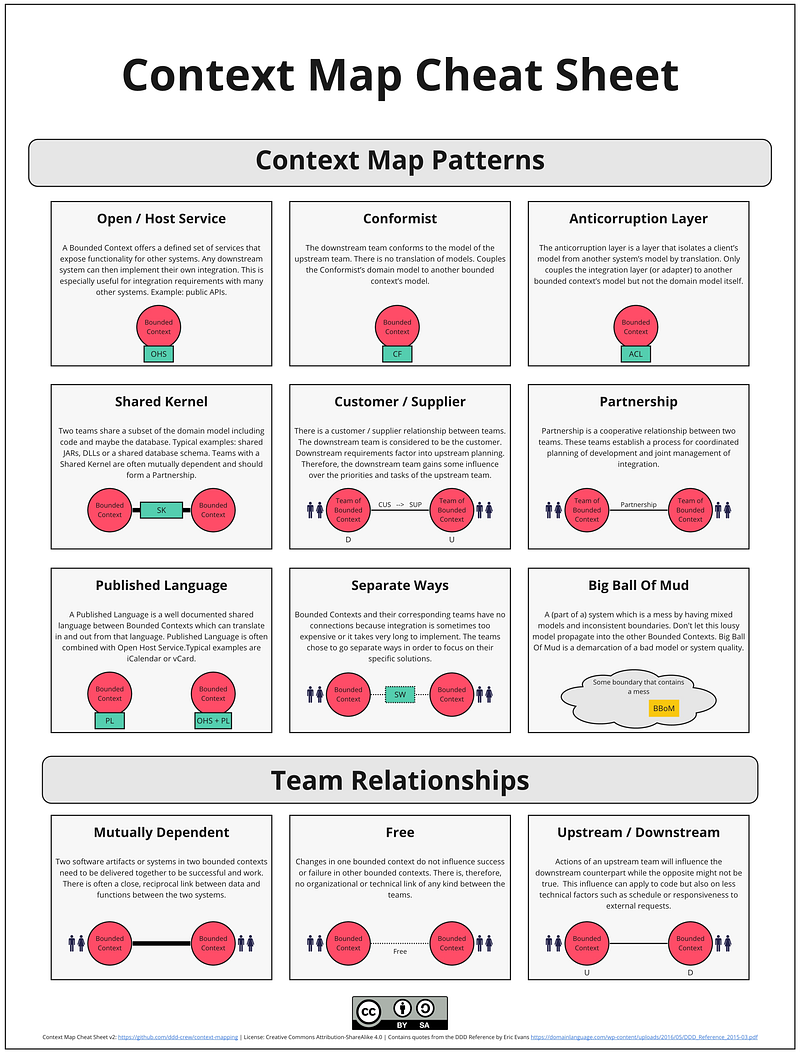
When teams reduce "domain" to the /domain folder of the project, the spirit of DDD is lost and the promise of aligning code with business becomes nothing more than a directory convention. I have seen this happen repeatedly: teams that adopt the surface structure of DDD without embracing its philosophy. They create entities, aggregates, repositories, the entire tactical apparatus of DDD, but without Ubiquitous Language, without collaborative modeling, without constant iteration with domain experts. The result is a simulacrum of DDD: an empty shell that looks sophisticated but delivers none of the promised benefits.
The true power of DDD does not lie in its tactical tools: aggregates, specifications, domain events. It lies in the mindset of placing the domain at the center of all decisions. When an architectural question arises, the question is not "which pattern should I use?" but "what does the domain require?". When a conflict emerges between performance and model clarity, the first question is "are we modeling correctly?", not "how do we optimize this query?". This does not mean ignoring technical constraints. It means prioritizing them correctly.
"The heart of software is its ability to solve domain-related problems for its user." — Eric Evans
Evans repeats this mantra because it runs counter to the natural tendency of developers: focusing on interesting technical challenges rather than important business problems. It is more fun to optimize an algorithm, experiment with a new framework, or debate concurrency patterns than to sit with a domain expert and understand how the credit approval process works. But it is in deep understanding of the domain that the real value of software resides. A technically mediocre system that solves the domain's problems well is more valuable than a technically brilliant system that misses the target.
Hexagonal Architecture: the domain as an isolated core
Hexagonal Architecture, also known as Ports and Adapters, was proposed by Alistair Cockburn in the early 2000s as a response to a common problem: systems where business logic was so entangled with frameworks, databases, and user interfaces that it became impossible to test in isolation or change without massive refactoring. Hexagonal Architecture proposes a radical separation: the application's core, the domain, must be completely independent of any external technical detail.
"Allow an application to equally be driven by users, programs, automated test or batch scripts, and to be developed and tested in isolation from its eventual run-time devices and databases." — Alistair Cockburn

This quote captures the essence of the proposal: the domain should be agnostic about how it is triggered or where it persists data. If you can test your business logic without starting a database, without launching a web server, without heavy frameworks, you have achieved the hexagonal ideal. The domain communicates with the outside world through "ports" (abstract interfaces) and "adapters" (concrete implementations of those interfaces). This inverts the dependency: it is not the domain that depends on infrastructure, it is the infrastructure that adapts to the domain.
In practice, this means that the "domain" in hexagonal architecture is the code that contains business entities, business rules, and, depending on interpretation, also use cases or application services. Here begins one of the ambiguities: different practitioners of hexagonal architecture position use cases differently. Some place them inside the hexagonal core; others place them in an intermediate layer between the core and the adapters. This ambiguity is not accidental. It reflects real tensions about what constitutes "pure domain logic" versus "application logic."
I worked on a project where this tension manifested clearly. We had a use case called "ProcessOrder" that orchestrated several domain entities, made calls to external payment services, and sent email notifications. The question arose: does this belong to the domain? Some argued yes, because it is essential business logic. Others argued no, because orchestration and integration with external services is an application responsibility, not a domain one. Both sides had a point, depending on how you define "domain" in hexagonal architecture.
The strength of hexagonal architecture lies in its clarity about dependencies: the domain cannot depend on anything external. But it leaves important questions open about granularity and responsibilities. What exactly goes inside the hexagon? Only pure business entities and rules? Or also the coordination between those entities? What about domain services that implement rules that do not naturally fit into a single entity? What about domain events? Cockburn provides principles but not detailed prescriptions, which is both a strength (flexibility) and a weakness (ambiguity).
The great insight of hexagonal architecture is treating all external interfaces: UI, database, messaging, third-party APIs, as equivalent adapters. There is no special privilege for the database. It is just another technical detail: replaceable, secondary. This is a powerful mental inversion that frees the developer to think first about the domain, and only then about how to persist, display, or communicate results. The hexagonal domain is sovereign: it defines interfaces that the external world must implement, not the other way around.
Onion Architecture: the domain as the absolute center
Onion Architecture, proposed by Jeffrey Palermo in 2008, is an evolution of hexagonal architecture with an even greater emphasis on domain purity. The onion metaphor is deliberate: concentric layers where the domain sits at the innermost center, fully protected, and each outer layer adds progressively more technical and less conceptual responsibilities. The fundamental rule is simple and inflexible: dependencies always point inward, never outward.

The domain in Onion Architecture is the core of the onion, containing exclusively business entities, value objects, and pure domain rules. Around it comes the domain services layer, then the application layer (containing use cases and orchestration), and finally the infrastructure layer (persistence, UI, external APIs). This hierarchy is more prescriptive than hexagonal architecture. There is no ambiguity about where use cases belong: they are outside the domain, in the application layer.
This rigid separation has philosophical implications. The domain in Onion represents the Platonic essence of the business: the immutable truths, the fundamental rules that would remain true even if we completely changed the technology, the database, the interface. A rule like "an order cannot be finalized if it has items with insufficient stock" is a domain truth, independent of how we implement the system. A rule like "when finalizing an order, send a confirmation email and update the distributed cache" is application logic: important, but not essential to the domain.
This distinction seems elegant in theory but is challenging in practice. Few domains have truly Platonic rules, independent of context. Most business rules are contingent, contextual, full of exceptions and special cases. Consider an apparently simple rule: "maximum allowed discount is 20%." That seems like a pure domain rule. But then exceptions emerge: managers can approve up to 30%, directors up to 50%, and for VIP customers there is no limit. The pure rule dissolves into organizational politics and hierarchy. What was domain becomes application.
Despite these difficulties, Onion Architecture offers a valuable regulatory ideal. It forces us to constantly ask: "is this really part of the domain, or is it just application logic in disguise?" This question disciplines architectural thinking. It prevents the domain from becoming a dumping ground where we throw any logic we do not know where to place. It keeps the core lean, focused, comprehensible.
I worked on a financial system where we took Onion Architecture to the extreme. The domain core had zero external dependencies: not even third-party libraries for date or decimal manipulation. We used only primitive types and language constructs. This made the domain trivially testable and portable. But the cost was steep: lots of boilerplate code, reinvention of basic structures, complexity in converting between domain types and infrastructure types. Purity had a price.
The lesson I learned is that Onion Architecture works better as a philosophy than as a dogma. The spirit: protecting the domain from technical dependencies, keeping business rules isolated and testable, is more important than the literal structure of concentric layers. Sometimes pragmatism requires compromising purity. The key is doing so consciously, knowing that you are taking on architectural debt, and documenting the reasons.
Clean Architecture: the domain split in two
Robert C. Martin, known as Uncle Bob, synthesized several architectural ideas in his Clean Architecture proposal, presented in the book of the same name. Clean Architecture does not invent radically new concepts, but organizes them pedagogically and prescribes clear rules. Its diagram of concentric circles has become iconic, visually representing the dependency hierarchy: outer layers (frameworks, databases, UI) depend on inner layers (use cases, entities), never the reverse.
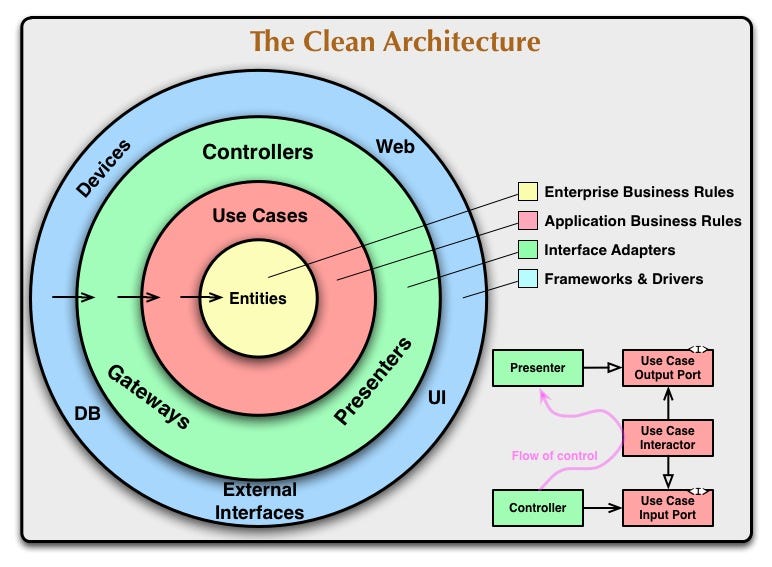
What distinguishes Clean Architecture is its explicit division of "domain" into two layers:
- Entities (Enterprise Business Rules): Higher-level business rules, generally generic and reusable across multiple applications. These are the organization's fundamental rules.
- Use Cases (Application Business Rules): Rules specific to a particular application that orchestrate entities to accomplish concrete tasks.
"The entities encapsulate enterprise-wide business rules. An entity can be an object with methods, or it can be a set of data structures and functions. It doesn't matter so long as the entities could be used by many different applications in the enterprise." — Robert C. Martin
This quote clarifies that entities are not simply domain classes. They encapsulate business rules that transcend individual applications. If your company has multiple systems dealing with "Customer" or "Product," the definition of Customer or Product as an entity should be shareable across those systems. This is ambitious and rarely achieved in practice, but it reveals Martin's intention: distinguishing between durable business knowledge (entities) and transient application logic (use cases).
The subdivision of domain into entities + use cases is both a clarification and a source of confusion. It clarifies because it makes explicit that not all important logic is "pure domain logic." There is application logic that is equally important but has a different nature. It confuses because now "domain" can mean both layers (entities + use cases) or only the entity layer, depending on who you ask.
When someone says "I'm working on the domain layer" in a project following Clean Architecture, it is ambiguous: are they working on entities? Use cases? Both? This ambiguity is only resolved by explicit team convention. Some teams call the entity layer "domain" and the use case layer "application." Others call both collectively "domain," distinguishing between "core domain" and "application domain." Still others avoid the term "domain" entirely, using only "entities" and "use cases."
"Nothing in an inner circle can know anything at all about something in an outer circle. In particular, the name of something declared in an outer circle must not be mentioned by the code in the inner circle. That includes functions, classes, variables, or any other named software entity." — Robert C. Martin
The Dependency Rule is absolute and non-negotiable in Clean Architecture. It ensures that changes in outer layers (choosing a new web framework, switching from a relational to a NoSQL database) do not affect inner layers. Entities know nothing about persistence. Use cases know nothing about HTTP. This is dependency inversion applied systematically across the entire architecture.
The strength of Clean Architecture lies in its didactic clarity. It is relatively easy to explain its principles to junior developers and keep them aligned. The concentric circles diagram becomes a shared visual language. The weakness lies in its rigidity: sometimes the boundaries feel forced, generating a lot of translation code between layers. But like all principled architecture, Clean Architecture prioritizes long-term evolvability over short-term convenience.
DDD, Hexagonal, Onion, Clean: variations on a theme
We have reached the point where we need to confront an uncomfortable question: are these architectures truly different, or do they simply use different terminology to describe the same ideas? The answer is: both. They share a fundamental philosophy, isolating business logic from technical details, but they diverge in prescriptions, boundaries, and emphases. And these divergences matter when teams need to concretely decide where to put code.

Consider a service that processes payments. It needs to:
- Validate the order
- Check stock availability
- Calculate taxes and discounts
- Call an external payment gateway
- Persist the transaction in the database
- Send a confirmation email
- Publish an event to update analytics
Now ask practitioners of each architecture: "where does each piece of this flow go?" You will receive different answers:
Pure DDD would say: validation, tax calculation, and business rules belong in entities and domain services. The gateway call and email sending are application services that use the domain. Persistence is implemented by repositories (whose interface is defined in the domain but implemented in the infrastructure).
Hexagonal would say: everything that is business logic goes in the central hexagon. The external gateway call and persistence are adapters. Email could be an adapter or part of the hexagon, depending on whether we consider "notify customer" a business rule or a technical detail.
Onion would be stricter: validation and calculations go in the domain core. Orchestration of the full flow belongs in the application layer. Gateway, persistence, and email are all infrastructure, in the outermost layer.
Clean would be similar to Onion but would make it explicit: business rule validation in entities, orchestration in the "ProcessPayment" use case, gateway and email as implementations of interfaces defined in the use case layer.
These are not trivial differences. They affect how we organize code, how we test, how we distribute responsibilities across the team. A developer coming from a Hexagonal project will find an Onion project strange because what they called "domain" has been subdivided into "core domain" and "application." A developer accustomed to Clean Architecture will miss the explicit distinction between entities and use cases in a Hexagonal project.
What these architectures have in common is more fundamental than their differences: all recognize that dependencies should point inward, that business logic should be isolated from technical details, that testability requires independence from infrastructure. These are universal principles. The differences are in how to materialize those principles: how many layers? Where to draw boundaries? How rigid should the rules be?
The tragedy is when teams argue about these differences without recognizing the fundamental agreement. I have seen heated debates about whether use cases "belong to the domain" consume hours of meeting time. In the end, it was a semantic dispute. Both sides agreed that business logic should be isolated and testable. They disagreed only about labels. Had they recognized this, they could have established a convention and moved on.
"The map is not the territory." — Alfred Korzybski
This phrase by the engineer and philosopher Alfred Korzybski reminds us that architectures are maps, not territories. They are models, not realities. The value of a map lies in its usefulness, not in its absolute truth. Different maps serve different purposes. A road map is different from a topographic map, which is different from a political map. All represent the same territory but emphasize different aspects. In the same way, DDD, Hexagonal, Onion, and Clean are different maps of the same territory: organizing code to protect business logic. Choose the map that best serves your purpose, but do not confuse the map with the territory.
The technical domain: when the database enters the conversation
So far we have discussed domain in the contexts of software architecture and business modeling. But there is another use of the term, completely distinct and frequently overlooked: domain in relational databases. In SQL, especially in PostgreSQL, Oracle, and other robust systems, you can create a DOMAIN: a custom data type with specific constraints.
CREATE DOMAIN email AS VARCHAR(255)
CHECK (VALUE ~ '^[A-Za-z0-9._%+-]+@[A-Za-z0-9.-]+\\.[A-Za-z]{2,}$');

CREATE TABLE usuarios (
    id SERIAL PRIMARY KEY,
    email_contato email NOT NULL
);
In this example, email is a domain, not in the DDD or architectural sense, but in the SQL sense: a data type with built-in validation rules. This has nothing to do with modeling the business or isolating logic. It is purely a database schema construct: a way to reuse type definitions and ensure data consistency.
This technical use of the term "domain" is completely orthogonal to the others. When a DBA talks about "creating domains in the database," they are talking about data types. When a software architect talks about "modeling the domain," they are talking about business logic. Same word, entirely different semantic universes. And this terminological collision generates real confusion.
I was in a meeting where a software architect suggested "modeling the domain in the database." He meant: creating a rich schema that reflected the entities and relationships of the business domain. The DBA understood: creating SQL DOMAINs for custom types. It took half an hour of cross-talk before someone realized they were using the same word with completely different meanings. Both left frustrated, each thinking the other did not understand the basics.
This terminological collision is no accident. It reflects a historical tension in software engineering between two schools of thought: one that sees the database as the center of the system (data-centric design) and one that sees application logic as the center (domain-centric design). In the data-centric approach, which dominated the industry in the 1980s and 1990s, the database schema is the model. Business rules are expressed in constraints, triggers, and stored procedures. The "domain" (in the sense of business logic) lives in the database.
In the domain-centric approach, which gained momentum with the rise of DDD and modern architectures, the database is merely a persistence detail. The domain lives in the application code, in rich objects with behavior. The database is dumb: a glorified byte store. Business rules are expressed in code, not in SQL.
These two philosophies are fundamentally incompatible, and the word "domain" is used by both. A domain-centric advocate will say: "the domain should be independent of the database." A data-centric advocate will say: "the domain is the database, that is where the rules are enforced." Both use "domain," but mean opposite things.
"Information asymmetry prevents optimal coordination." — George Akerlof
Akerlof won the Nobel Prize in Economics partly for his work on markets with asymmetric information. When sellers know more than buyers (or vice versa), markets function poorly. The same dynamic occurs in development teams with semantic asymmetry. When architects and DBAs use the same term with different meanings, communication "trades" generate suboptimal value. Decisions are made based on flawed understandings. Code reflects compromises that nobody actually wanted.
The solution is not to standardize vocabulary: it is impossible to force DBAs to stop using "domain" in the SQL sense. The solution is semantic awareness: recognizing that the word is overloaded and always clarifying the context. When I say "domain," am I talking about a SQL type or business logic? This small clarification prevents hours of confusion.
Domain as a linguistic and social construct
"The limits of my language mean the limits of my world." — Ludwig Wittgenstein
Wittgenstein, in Philosophical Investigations, proposes that meaning is not intrinsic to words but emerges from their use in social contexts, "language games," as he calls them. Software engineering is a complex language game, with multiple sub-games (DDD, systems architecture, database administration, business engineering). The term "domain" participates in several of these sub-games, taking on slightly different meanings in each.
When a DDD practitioner uses "domain," they are playing the language game of domain-driven design, where terms like "entity," "aggregate," "bounded context" have specific meanings established by community convention. When an enterprise architect uses "business domain," they are playing the language game of corporate architecture, where terms like "capability," "end-to-end process," "responsibility matrix" are relevant. These games overlap but are not identical.
The DDD Ubiquitous Language is an attempt to create a shared language game between developers and business experts. It is a conscious effort to align semantics, establishing a common vocabulary where "order," "customer," "payment" mean precisely the same thing for all participants. This is difficult. Developers have technical language habits; business experts use terms colloquially and ambiguously. Ubiquitous Language demands discipline from both sides.
"Communicative action seeks mutual understanding, not merely strategic success." — Jürgen Habermas
Habermas, philosopher of the Frankfurt School, distinguishes between communication oriented toward understanding and communication oriented toward manipulation. In the context of development teams, this translates to: are we truly trying to understand each other, or just trying to win arguments? When an architect and a developer debate where to place certain logic, are they trying to reach a shared understanding of the best architectural structure? Or is each one trying to impose their view?
The polysemy of "domain" becomes problematic when communication is not oriented toward understanding. If people assume their definitions are obvious and universal, if they make no effort to clarify context, if they interpret disagreement as incompetence rather than semantic difference, then the term becomes a source of conflict rather than clarity.
I worked on a team where this dynamic reached a critical point. We had developers from different backgrounds: some came from hexagonal projects, others from pure DDD projects, still others from legacy systems with no clear architecture. When we discussed architecture, we used "domain" constantly, but each person had a different mental image. The discussions were frustrated and unproductive until we held an explicit workshop: we spent four hours drawing diagrams, comparing definitions, establishing a shared glossary. It was tedious but transformative. Afterward, our architectural discussions became substantive, not semantic.
The lesson is that shared language does not emerge spontaneously. It must be intentionally built. High-performing teams invest time in aligning semantics. They create glossaries. They draw diagrams together. They review naming conventions. They question ambiguous terms. This may seem like overhead, but it is investment. Every hour spent aligning language saves dozens of hours of subsequent confusion.
"Domain" in the deepest sense is not code, not documentation, not UML. It is the shared understanding that exists in the team's collective mind. When that understanding is strong and aligned, code reflects it naturally. When it is weak and fragmented, no sophisticated architecture will save the project. Software architecture is, fundamentally, the architecture of understanding.
The fallacy of the generic domain and anti-DDD
One of the most common distortions in the use of the term "domain" is what we might call the generic domain or anemic domain: a layer labeled "domain" that contains little more than POJOs (Plain Old Java Objects), DTOs (Data Transfer Objects), or entities without behavior. These classes typically have only getters and setters, with no business logic. All real logic lives in "services" that manipulate these passive data structures.
This practice arises from the uncritical importation of terms: using the word "domain" because it sounds architecturally correct, because it is what popular frameworks expect, because everyone else is doing it. But without understanding what the term implies conceptually. The result is a simulacrum of domain modeling: the appearance of sophisticated architecture without the substance.
"The anemic domain model is really just a procedural style design, exactly the kind of thing that object bigots like me (and Eric) have been fighting since our early days in Smalltalk." — Martin Fowler
Martin Fowler coined the term "Anemic Domain Model" and argued strongly against it. The anemic model violates fundamental object-oriented principles: encapsulation, cohesion between data and behavior. More importantly, it violates the spirit of DDD, which sees entities as rich objects with behavior, not as passive data structures.
Why is the anemic domain so common? Several reasons. First, it is easier. It does not require deep thinking about where logic belongs: everything goes in services. Second, many frameworks (especially ORMs like Hibernate or Entity Framework) encourage this design, treating entities as mere table mappings. Third, many developers learned procedural programming first and only superficially adopted object orientation. For them, objects are glorified data structures, and all logic naturally lives in separate functions/methods.
But the cost of the anemic domain is steep. When logic is scattered across disconnected services, understanding the system's behavior becomes difficult. You need to read multiple files, follow multiple call chains, maintain complex mental context. Business rules that should be localized, like "an order can only be canceled if it has not been shipped," end up scattered. Perhaps the order service checks this in one place, the cancellation service in another, the public API in a third. Duplication, inconsistency, and bugs are inevitable.
Furthermore, an anemic domain makes refactoring risky. If an entity is just data, changing it affects all services that manipulate it. There is no encapsulation protecting invariants. Any service can put the entity in an invalid state. Tests become complex because you need to mock many services interacting in intricate ways.
This confusion is analogous to what Karl Popper called empty nominalism: using words with theoretical prestige without commitment to their empirical substance. Calling something "domain" does not make it a well-modeled domain, just as calling something "science" does not make it scientific. The name is easy; the substance is hard.
"The difference between the almost right word and the right word is really a large matter: it's the difference between the lightning-bug and the lightning." — Mark Twain
Twain was talking about literary writing, but the principle applies perfectly to software architecture. Using "domain" to label a folder of anemic POJOs is using "almost the right word." It looks right but misses the essence. The difference between a rich domain (entities with behavior, encapsulated rules, Ubiquitous Language) and an anemic domain (glorified DTOs) is the difference between the lightning and the lightning-bug.
The solution is not simply adding methods to entities. It is fundamentally rethinking what entities are. They are not database tables reflected in code. They are business concepts with identity, behavior, and responsibility. An "Order" entity should know how to calculate itself, how to validate itself, how to change state. It should not be passively manipulated by external services.
Organizational noise and the cost of ambiguity
The lack of clarity around the term domain is a type of organizational semantic noise. In agile teams, where communication flows continuously and decisions are decentralized, small conceptual divergences amplify over time. It is like genetic drift in biology: small random mutations that, in isolation, are irrelevant, but accumulated over generations produce significant divergence.
One developer believes "use cases belong to the domain." They structure their code placing flow orchestration inside the domain module. Another developer, with a different background, believes "domain is only entities and pure rules." They place use cases in a separate layer. Both contribute to the same codebase. The result? Inconsistent code. Some use cases inside the domain, others outside. Some services that mix responsibilities, others that separate them rigorously.
This inconsistency is not merely aesthetic. It has real costs:
Cognitive cost: New developers (and even veterans) cannot predict where to find certain functionality. "Where is the order approval logic?" Should it be in the domain? In the application? In a service? One has to search, guess, or worse, ask repeatedly.
Maintenance cost: Changes require understanding multiple code organizations. Adding a new business rule requires understanding where it should go, and the answer is inconsistent with the project's own precedent.
Testing cost: Testing strategies become heterogeneous. Some modules are easily testable because they separate domain from infrastructure. Others are entangled and require heavy integration tests. Test coverage becomes a patchwork.
Political cost: Architecture discussions become territorial disputes. "My part of the code is right; yours is wrong." With no objective criteria for judgment, these disputes do not resolve. They merely perpetuate.
"In a market for lemons, the average quality of traded goods decreases because of information asymmetry." — George Akerlof
Akerlof studied markets where sellers know more about product quality than buyers (example: used cars). In these markets, bad products ("lemons") drive out good ones because buyers cannot distinguish them. Price drops to reflect average quality, so sellers of good products leave the market, lowering average quality even further. It is a vicious cycle.
In codebases where architectural quality is hard to distinguish (due to semantic noise and inconsistency), a similar dynamic occurs. Developers who care about architecture become frustrated because they cannot establish standards. Developers who do not care contribute code of low architectural quality because "that is how it is already being done." Average quality drops. Good developers eventually leave, exacerbating the problem.
This is not merely an analogy. It is an empirical observation. I have seen projects where semantic noise about "domain" eventually led to the complete degradation of architecture. Layers that should have been isolated became fully entangled. Tests became impossible without standing up the entire infrastructure. Build time grew from seconds to minutes. Deployment became risky because nobody understood the real dependencies. The project was eventually scrapped and rewritten.
The cost of ambiguity, therefore, is not just inefficient communication. It is progressive architectural degradation until the point where maintenance cost exceeds the value generated. And it all starts with something apparently trivial: failing to align the meaning of a single word.
Between philosophy and pragmatism: domain as practice
There is something philosophical about the discussion around domain. We are ultimately asking: what is essential and what is accidental? What belongs to the nature of the problem and what is an artifact of the solution? These are Aristotelian questions: substance versus accident, form versus matter.
Software architecture, when taken seriously, is an exercise in applied philosophy. Not just "where do I put this class?" but "what is the nature of this responsibility?". Not just "how do I implement this feature?" but "how do I model this aspect of reality?". These questions demand both technical competence and conceptual clarity.
"Science is what we understand well enough to explain to a computer. Art is everything else we do." — Donald Knuth
Knuth, one of the fathers of computer science, acknowledges that our discipline is as much art as science. Domain modeling is art: it requires intuition, sensitivity, interpretation. Two competent people can model the same domain in different ways, both valid. There is no algorithm for finding the correct model.
But this does not mean "anything goes," that all models are equivalent. There are better and worse models: more or less faithful to the domain, more or less expressive, more or less sustainable. Judging which is better requires experience, context, and frequently debate. It is a hermeneutic judgment, not an algorithmic one.
The tension between philosophy and pragmatism is constant. Philosophically, we want pure domain, independent of all technical contamination. Pragmatically, we need to compromise. Persistence, performance, framework constraints: all of these affect how we model the domain. The purist developer who insists on absolutely isolated domain frequently generates so much boilerplate that productivity collapses. The pragmatic developer who ignores separation of concerns produces code that is fast to write but impossible to maintain.
Wisdom lies in navigating this tension consciously. Knowing when it is appropriate to compromise architectural purity (urgent deliveries, prototypes, trivial systems) and when it is essential to maintain it (core business, critical systems, long-lived products). Knowing when architectural refactoring is worth the cost and when it is gold-plating.
I worked with a brilliant architect who had a principle: "Architecture is about reversible versus irreversible decisions. Invest in making the right decisions irreversible." The choice to isolate or not isolate the domain is relatively irreversible. Once business code is mixed with infrastructure code, untangling it is costly. Therefore, this is a decision where it is worth investing in getting it right from the beginning. On the other hand, the choice of which logging library to use is easily reversible. It is not worth spending hours debating exhaustively.
The domain is one of those structuring decisions that defines the project's trajectory. Getting the domain wrong does not immediately doom the project, but it creates technical debt that grows exponentially. Each new feature is a little harder. Each bug is a little more obscure. Each refactoring is a little more risky. Eventually, the project reaches a point where any change is dangerous and costly. The only way out is a rewrite.
Stories from the field: when theory meets reality
Let me share some real (anonymized) stories that concretely illustrate how confusion about "domain" manifests in real projects.
Story 1: The domain that was a database
In a financial project for a large insurance company, the team had decades of experience with mainframe and Oracle systems. For them, "modeling the domain" meant designing the entity-relationship model, creating normalized tables, establishing foreign key constraints, writing triggers for business rules. When the company decided to modernize and hired new developers with expertise in modern architecture, conflict was immediate.
The new developers wanted to create a domain layer with rich objects, isolated from the database. The veterans found this absurd: "the domain IS already modeled, in the database!" For them, creating "another representation of the domain" in code was unnecessary duplication. The discussions were frustrating because both sides used "domain" to mean different things. For the veterans, domain = database schema. For the newcomers, domain = business objects in code.
The project failed to integrate the two views. They ended up with an unhappy hybrid: part of the logic in triggers and stored procedures, part in Java services, with no clear separation of responsibilities. The system worked, but it was a nightmare to maintain. No developer understood the full flow. Bugs appeared in unexpected places. Changes required synchronized modifications to both database and code, frequently desynchronized in practice.
Story 2: The domain that was in everything and in nothing
An e-commerce startup adopted DDD after the CTO read Eric Evans's book. Everyone was excited. They created a /domain folder in the project. They moved code there. They celebrated that they now had "modern architecture."
But nobody actually understood DDD. The /domain folder became a dumping ground: anemic entities, DTOs, utilities, helpers, various validations, even payment API integration code. There were no bounded contexts, no Ubiquitous Language, no well-defined aggregates. It was procedural code organized into classes, with a fancy "domain" label.
Worse: because everything was "in the domain," nothing was isolated. Domain code depended directly on HTTP libraries, JSON serialization frameworks, database clients. Tests required spinning up nearly the entire application. There was no real architectural gain, only an illusion created by the label.
When a new CTO came in (the previous one left after a frustrating funding round), he was initially impressed: "you use DDD!" Then, upon examining the code, he was horrified: "this is not DDD; it is chaos organized into folders." The refactoring took months.
Story 3: The split domain and the architects' war
At a large consulting firm, two senior architects led different teams in the same program. One religiously followed Clean Architecture; the other preferred Hexagonal. Both teams implemented microservices that needed to integrate.
The Clean team had clear separation: /entities for pure business rules, /usecases for orchestration. The Hexagonal team had a single /domain containing both. When integrations began, a problem emerged: API contracts reflected different internal organizations. What the Clean team called a "domain service," the Hexagonal team called a "port." What one saw as an "entity," the other saw as an "aggregate."
Technically, both systems worked well individually. But integration was a conceptual nightmare. Documentation used different terminologies. Design discussions were confusing because each side interpreted proposals through its own architectural framework. Alignment meetings became philosophical debates about architecture.
The program fell behind schedule. Stakeholders could not understand why "architecture problems" caused so much delay, since both systems worked. Resolution came only when they brought in an external architect to establish a common vocabulary and mediate translations between the two approaches. But the cost in time and morale was significant.
Domain as discipline: going beyond code
If there is one lesson that runs through all discussions about domain, it is this: domain is more than code. It is a discipline of thought. It is the practice of constantly asking "what really matters here?" and "how does this relate to the business?". It is resisting the temptation to jump straight into implementation and first investing in understanding.
"Weeks of programming can save hours of planning."
This ironic phrase captures a deep truth: time invested in understanding the domain and planning the model saves multiples in implementation time. But there is a strong cognitive bias toward action. Developers want to write code. Managers want to see progress. Planning feels unproductive. So we jump to code and discover problems when we already have thousands of lines written.
DDD and its associated architectures are, fundamentally, disciplines of restraint: restraint from the impulse to code prematurely, restraint from the impulse to optimize prematurely, restraint from the impulse to complicate prematurely. They say: first understand the domain, then model, then choose the architecture, then implement. This order matters.
But discipline is hard. It requires individual and organizational maturity. Teams under pressure for fast delivery have no patience for "philosophizing about the domain." Product owners do not understand why "modeling" takes so long. The pressure is always to "code faster," not "think deeper." And then we reap the consequences: systems that work but do not make sense. Code that passes the tests but does not reflect the business. Architectures that are technically correct but conceptually hollow.
Domain as discipline also means rejecting ready-made solutions without critical thinking. Not adopting DDD "because that is what everyone does," not applying Clean Architecture "because Uncle Bob said so," not using microservices "because it is trendy." Instead: deeply understanding what each approach proposes, why it proposes it, what problems it solves and what problems it creates. And then choosing consciously, contextually.
It also means accepting that there is no universal recipe. The domain of a fintech is different from the domain of a social network, which is different from the domain of an embedded system. The same techniques do not apply universally. DDD makes enormous sense for systems with complex and mutable business logic; it makes little sense for simple CRUD systems. Hexagonal Architecture is valuable when you anticipate frequent infrastructure changes; it is unnecessary overhead for disposable prototypes.
Architectural maturity lies in knowing how to adapt principles to contexts, not in applying patterns dogmatically.
Conclusion: the domain of communication
In the end, the true domain we need to understand is that of communication. Software engineering is an exercise in constant translation between worlds: business, code, infrastructure, team. Each context uses "domain" to talk about a piece of that reality. Ignoring the context is confusing the worlds and poorly designing the bridge between them.
Evans, Cockburn, Palermo, and Martin did not create incompatible concepts. They created different vocabularies for distinct problems. The noise arises when these vocabularies mix without mediation. This is the point where philosophy becomes pragmatic: understanding the language is understanding the system. Wittgenstein already knew: "the meaning of a word is its use in the language." In software engineering, the use of "domain" varies dramatically. Recognizing this variation is the first step toward effective communication.
The polysemy of "domain" is not a problem to be eliminated. It is a reality to be navigated. Different communities of practice (DDD, corporate architecture, database administration) legitimately use the term in different ways. Forcing unification would impose semantic impoverishment. What we need is not a single vocabulary but semantic awareness: knowing that we are using a polysemous term and always clarifying context.
Talking about "domain" without understanding the context is like trying to play a symphony where each musician reads a different score. The result is noise, not harmony. And all good architecture, in the end, is the art of eliminating noise: technical, conceptual, and human. It is building systems that make sense at multiple levels: they compile correctly, they execute efficiently, but they also communicate clearly their intentions.
"Programs must be written for people to read, and only incidentally for machines to execute." — Harold Abelson
Abelson, co-author of the classic Structure and Interpretation of Computer Programs, reminds us that code is, above all, human communication. The compiler does not care whether you call something "domain" or "core" or "business." But humans care. The choice of terms shapes understanding. Well-chosen terms make a system comprehensible; poorly chosen terms obscure intentions.
"Domain," in all its senses, is about building bridges of understanding. Between business and technology. Between problem and solution. Between experts and developers. Between reality and its computational representation. These bridges are fragile and require constant maintenance. They require dialogue, clarification, refinement. They require humility to recognize when we are not understanding each other, and patience to align vocabularies.
The best software architecture is not the most technically elegant or the most conceptually trendy. It is the one that best communicates its intentions to future maintainers, who may be you yourself six months from now. It is the one that establishes clear boundaries based on deep understanding of the domain (in whichever sense you are using the word, as long as it is clear which). It is the one that facilitates evolution because its abstractions are robust and well-grounded.
So the next time you or your team uses the word "domain," pause for a moment. Ask yourself: "what do we actually mean here?" Is it domain in the DDD sense: entities and business rules? Is it domain in the architectural sense: the application's isolated core? Is it domain in the corporate sense: an area of organizational responsibility? Is it domain in the database sense: a custom data type? Clarify. Align. Share understanding.
This small discipline, semantic precision, is what distinguishes average teams from excellent ones. Average teams debate terms indefinitely. Excellent teams align vocabularies quickly and focus on substantive work. Average teams assume "everyone knows what domain means." Excellent teams know that nobody knows until it has been made explicit.
In the end, software architecture is the architecture of understanding. And you cannot architect understanding on unstable semantic foundations. Clarify your terms. Understand your contexts. Build your bridges. The code will thank you, the team will thank you, and the business will thank you.
Final Note: This article does not prescribe which definition of "domain" is correct, because there is no single correct definition. The goal is to make the multiple definitions explicit so that teams can consciously choose which to adopt and communicate it clearly. Clarity, not uniformity, is the objective.